
Jupiter is the largest planet in our solar system and the fifth planet from the Sun. Often called the “king of the planets” because of how massive and powerful it is, Jupiter is originally named after the Roman king of the gods and stands out because of its size, intense storms, and number of moons. Scientists have tried studying Jupiter for hundreds of years; more recently though, NASA’s Juno spacecraft has been collecting data about the planet and its moons since 2016.
One of the most impressive features of Jupiter is its size. Jupiter is more massive than all the other planets in our solar system combined. To put that into perspective, over 1,300 Earths could fit inside it. Jupiter is about 778 million kilometers away from the Sun, which is around 5.2 astronomical units. This distance causes Jupiter to take much longer than Earth to complete one orbit around the Sun.
Jupiter is known as a gas giant, which means it does not have a solid surface like Earth. A gas giant is formed from gas and dust that surrounds a new star. At first, tiny bits of rock and ice stick together and slowly build up into larger and larger objects. Once a forming planet gets big enough, it can start to hold on to a thin atmosphere. As it grows, its gravity gets stronger and pulls in more gas from the disk, making the atmosphere thicker and hotter. When the forming planet reaches a certain mass, it begins pulling in gas faster and faster, eventually gathering huge amounts of hydrogen and helium from the disk to become a massive gas giant like Jupiter. This process, called core accretion, is one of the main ideas scientists use to explain how gas giants form, although there are still details that researchers are working to understand.
Even though it is made of gas, a spacecraft could not just fly through Jupiter safely. The deeper you go into the planet, the hotter and denser it becomes; these crushing pressures would destroy any spacecraft. Scientists believe that because of its mainly hydrogen and helium make up, the core of the planet may be fuzzy and partially dissolved instead of solid. Interestingly, Jupiter has the strongest magnetic field of any planet in the solar system; because of this, intense radiation and “auroras” are created near the planet’s poles, similar to northern lights on Earth.
Jupiter is sometimes called a “failed star” because it is made of the same basic elements as the sun. If Jupiter had been much larger, it could have had enough pressure to start nuclear fusion and become a star. However, it never gained enough mass, so it remained a planet.
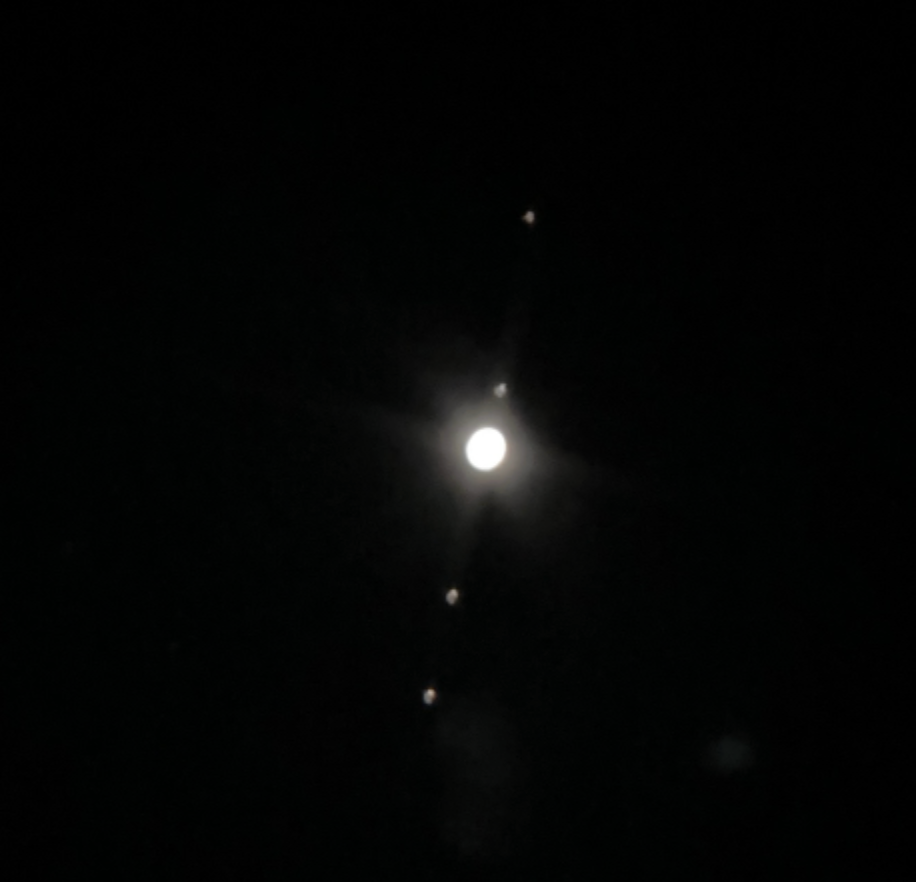
Jupiter’s appearance is also very unique. The planet’s colorful cloud bands that wrap around it are caused by 335 mile per hour winds. The lighter bands (not shown in figure 1), are made of frozen ammonia crystals, while the darker bands contain different amounts of chemicals. The most famous feature, the Great Red Spot, is a massive storm that has been raging for over 300 years. Along with this, Jupiter also has 79 known moons. The four largest moons, seen as the four star-like specks around Jupiter in figure 1, are Io, Europa, Ganymede, and Callisto. These are called the Galilean moons because they were discovered by Galileo in 1610. While scientists have confirmed there is no evidence of life on Jupiter or its moons, they have suggested that airborne life could possibly exist in parts of Jupiter’s atmosphere where temperatures are similar to Earth’s, but this idea is still a theory.
Figure 1: Picture of Jupiter (pictured above story)
Figure 1 is an image of Jupiter captured using a telescope and a phone. To take the image, a phone was set up to look through the telescope’s eyepiece. The telescope used had a 25 mm lens and a 6-inch mirror with a 750 mm focal length. This creates an optical magnification of 30 times. A laser finder connected to the telescope was used to locate Jupiter, and the phone’s exposure was lowered while night mode was turned off. A 5-second timer helped reduce movement and make the image clearer. Due to the brightness of Jupiter, it was difficult to find the “strips” and fully see the planet.
Overall, Jupiter is one of the most fascinating planets in the solar system. Its massive size, powerful storms, strong magnetic field, and unique moons make it an important object of study. With missions like Juno continuing to send back data, scientists are still learning new things about Jupiter and how it helped shape the solar system we live in.
Work Cited
“Steam Worlds: The Mystery of How Gas Giants Form.” Carnegiescience.edu, 12 June 2024, carnegiescience.edu/news/steam- worlds-mystery-how-gas-giants-form.
Choi, C. (2017, September 19). Planet Jupiter: Facts About Its Size, Moons and Red Spot. Space.com https://www.space.com/7-jupiter-largest-planet-solar-system.html
NASA. (2024). Jupiter – NASA Science. Science.nasa.gov. https://science.nasa.gov/jupiter/