
Did the American Revolution live up to the values of the Declaration of Independence?
Founding Fathers vs Equality
Although the Founding Fathers clearly established rights that benefited white males, their clear beliefs excluded people of color and forced African Americans to persevere to reality the ideas and principles that the Founding Fathers claimed to be America’s foundation.
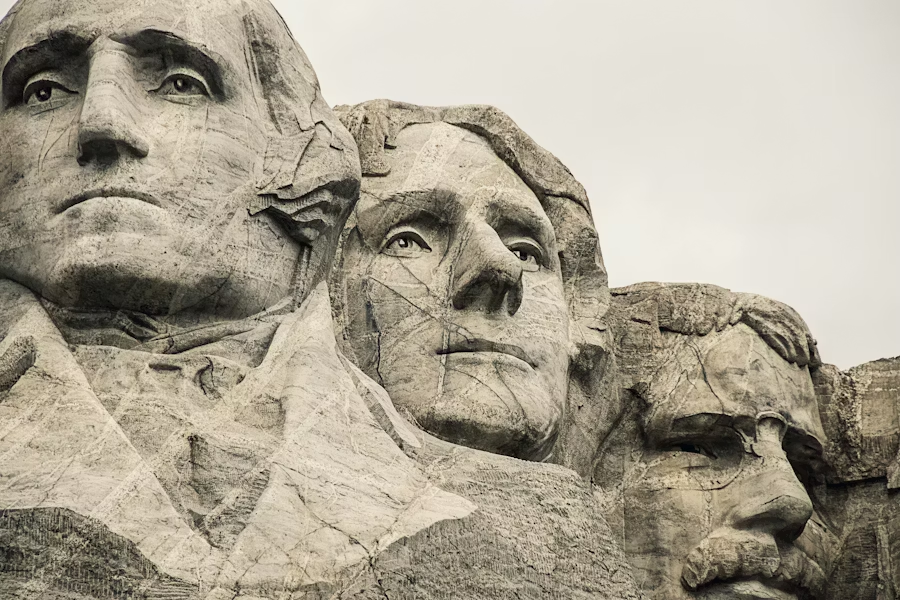
America’s Founding Fathers established many rights that were supposedly for the benefit of all Americans, but in fact mostly benefited the white men of the country. These rights included various freedoms, including free speech and legal rights such as only white men being able to vote at the time. However, the Founding Fathers, including Geroge Washington and Thomas Jefferson, owned slaves themselves. Thomas Jefferson spoke often about freedom, yet owned over 600 slaves (Slavery at Monticello). George Washington’s estate in Virginia was reliant on slaves (Washington & Slavery). The Founding Fathers’ early beliefs excluded people that were not white males from voting. Jefferson was caught stating that he believed “in every country, the blacks are inferior to the whites in the endowments both of body and mind” (Jefferson pg 189). Overall, their work shows the complicated early history of the United States and a topic that still sparks debate to this day. Slavery has been referred to as America’s “original sin” (America’s original sin). This is because, although slavery was debated by the Founding Fathers and framers of the Constitution, in the end they agreed that the Constitution would not ban slavery. Not only did the original Constitution not ban slavery, it provided that slaves would only count as three-fifths of a person for purposes of a state’s representation in Congress (Slavery & the Making of America).
Any discussion of the history of American democracy would be incomplete without including the struggle of African Americans to enjoy its promises. The uphill climb against discrimination is ironically traced back to the Founding Father’s concepts of rights and who should have them. “Black Americans have fought to make the ideals of democracy real for centuries, pushing the country closer to its stated principles.” (Hannah-Jones). This distinction between ideals and reality, and the constant effort to bring the two closer together, defines the struggle for Black Americans. The progress towards civil rights was due to the perseverance of Black Americans and the activists that stood up to get the rights that were promised to all Americans by the Founding Fathers. In referring to the Constitution in The 1619 Project, Nikole Hannah Jones stated “It is we who have been the perfecters of this democracy, and not the white men who first drafted it” (Hannah-Jones). In other words, it wasn’t the Founding Fathers and the framers of the Constitution that delivered Americans democracy as a finished product but the struggles of African Americans to make sure that the stated principles of democracy were applied to everyone equally. This shows that a large part of America’s progress is in fact a minority standing up against what is wrong.
Wrapping up, the Founding Fathers did a disservice to the democratic principles that they claimed to promote by establishing rights that benefited only themselves. Even such important figures as Geroge Washington and Thomas Jefferson did not fully live up to the democratic ideals that they claimed to live by. It took the efforts of African Americans and others to recognize and challenge this problem in American democracy, and proceed to shape what is modern day America by playing a huge part in the advancement of freedom and civil rights.
Works Cited
Hughes, Dwight. “Slavery: America’s “Original Sin”? – Emerging Civil War.” Emerging Civil War, 28 Feb. 2024, emergingcivilwar.com/2024/02/28/slavery-americas-original-sin/.
Jefferson, Thomas. Notes on the State of Virginia. 582 382 NOTES on the STATE of VIRGINIA. 1832, ttps://tile.loc.gov/storage-services/service/gdc/lhbcb/04902/04902.pdf
PBS. “Slavery and the Making of America . The Slave Experience: Legal Rights & Gov’t | PBS.” Www.thirteen.org, 2004, www.thirteen.org/wnet/slavery/experience/legal/docs2.html.
“Ten Facts about Washington & Slavery.” George Washington’s Mount Vernon, www.mountvernon.org/george-washington/slavery/ten-facts-about-washington-slavery.
Thomas Jefferson Foundation. “Slavery at Monticello FAQs – Property.” Monticello, 2019, www.monticello.org/slavery/slavery-faqs/property/