
Sports have become a staple in nearly every American household over the past 50 years, connecting people across the country and the world. Religion is another important aspect of people’s lives, helping mentally and spiritually, and bringing communities together. As the years go on, the intersection of the two has become more significant and questions regarding their convergence continue to arise. The United States today is diverse with many different religions; with those different religions comes different rules, restrictions, and traditions. This topic is significant because the general public isn’t as educated on the various regulations many sport organizations and teams haven’t adapted to include and aid athletes who practice different religions. Jana El Alfy, a UConn women’s basketball player from Egypt, is a practicing Muslim; this past year, the world of collegiate basketball watched her go through Ramadan fasting while playing in the March Madness tournament. She then went on to win the championships with her team, all while respecting her religious practices. El Alfy’s situation and others like it bring to light the challenges faced by athletes when sports and religion intersect. With El Alfy as an example, how are other athletes who may have clothing restrictions or restrictions around gender due to their religion accommodated for in professional sports?
A majority of religious holidays or holy days fall on major sporting events throughout the year, such as Ramadan and March Madness, or how the NFL has games on Christmas.
The winter season is a busy time for a lot of athletes, with athletes who are in season going to games and others doing off season training and recovery. Both the NBA games (Arnold, 2024) and collegiate March Madness (Magliocchetti, 2025) run through the Muslim holiday of Ramadan where individuals fast from sunrise to sunset and overall is a “time for praying and community” (Britannica, 2025). Athletes who celebrate and take part in religious traditions like Ramadan have to work to find a balance between their two aspects of life without sacrificing one.
Athletes who are simultaneously committed to their religion are some of the strongest people, mentally and physically. These athletes aren’t just strong from working out but also from the support they receive from those around them, which takes a meaningful tradition or practice and makes it that much more significant. “Athletes like Jana El Alfy, who plays for the UConn Women’s Basketball team played during March Madness this year while fasting. Though there is no exception for her, her team and teammates did everything to help her be the best she could be during Ramadan. One teammate in particular would get up before sunrise and make El Alfy breakfast each morning” (Magliocchetti, 2025). Though there is a lot of focus on the individual struggle, it’s also important to look at how those around you can make a difference and provide support in your endeavors.
Islam isn’t the only religion that deals with different rules and restrictions during holy days or months; so does Judaism when celebrating Yom Kippur. Yom Kippur is the holiest day of the year in Judaism and is marked by a 25-hour period of fasting and intensive prayer, as well as seeking forgiveness from both God and fellow human beings. While Islam and Judaism may not be exactly the same, there are similarities between the two that athletes can relate to, especially when it comes to fasting. Similar to Jana El Alfy, another professional athlete played in a sporting event while fasting for Yom Kippur. “Max Fried, a pitcher for the Atlanta Braves, was fasting for Yom Kippur during the division series and wasn’t scheduled to play during that game. But, during the first inning, Fried was called to go into the game to relieve the starting pitcher even though he was fasting. Now players are given the choice if they want to play during Yom Kippur or to fast instead” (Gurvis, 2023).
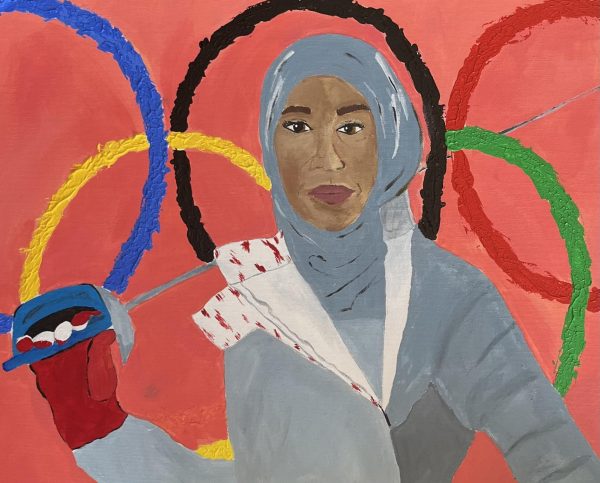
As an African American Muslim female who was often discriminated against for wearing a hijab, Ibtihaj Muhammad transformed the challenges she faced throughout her career and turned it into motivation to compete at the highest level. She went on to win an Olympic medal, all while advocating for her beliefs and religion. Ibithaj Muhammad started fencing at the age of 13 when her mother came up with the idea. Her mother thought that if her head was covered with the fencing equipment, then there would be no difference between Muhammad and any other athlete, eliminating the opportunity to discriminate and comment on Muhammads hijab. Muhammad quickly started to rise through the ranks and became a skilled fencer. She went on to fence for Duke University on a partial athletic scholarship. By the end of her time at Duke, she was ranked 4th in the United States for fencing. Along with being ranked 4th in the country, Muhammad became Senior World Team Champion in 2014 and medaled for Senior World Team 5 times throughout her career. If that wasn’t enough, Muhammad won the Olympic bronze medal in 2016 in Rio De Janeiro, becoming the first American woman to compete in the Olympics while wearing a hijab.
In the Islamic faith, women oftentimes will wear a head covering called a hijab and will dress modestly in general; this does not exclude when Muslim athletes practice or compete. In Ibtihaj Muhammad’s case, she received a lot of criticism and negative comments about the way she dressed modestly. Throughout her youth, parents in the athletic community would talk badly about Muhammad for wearing a hijab. They believed it would somehow compromise her ability to fence and could be “dangerous” for other children, and used this as an excuse to judge and berate her. The first year Ibithaj Muhammad competed in the Olympics was in 2016 in Rio. She walked away successful with a bronze medal, but faced adversity throughout her journey to bronze. At the Olympics, head coverings were thought to be a security concern and Muhammad was asked to remove her hijab for a security photo. There was a lot of public controversy over this, and many other Muslim athletes specifically from Egypt faced similar treatment and backlash. This thing that held religious significance and importance was being regarded as something as simple as a style choice and not as a symbol of devotion to their god and religion. Nearly a decade has passed, and similar events transpired in the 2024 Paris Olympics. During the games, France banned French athletes who wore headscarves from competing at the games. This discrimination drew international outrage and created a large problem for female athletes who practiced Islam. During this time, Ibithaj Muhammad condemned the ban on Muslim female athletes and stated that this was a “shameful moment for France.”
This athlete’s example connects to the overall topic because it shows a religious restriction that individuals of that faith chose to practice, and it is still being questioned and discriminated against by the outside world. It shows that many things have happened and changed over the past decade but simple things like accepting those who wear things such as headscarves still isn’t a universal acceptance and people need to be further educated and informed.
Clothing holds a significant importance in sports not just for fashion but in identifying teams, players and positions. But what happens when a player’s religion contradicts the design of the uniforms? In the Islamic religion, it is traditional for women to wear head coverings such as a head scarf or hijab. Many Muslim women make the choice to wear a hijab as a sign of devotion to their religion and to maintain modesty. During the 2024 Summer Olympics in Paris, this religious freedom was stripped from French female athletes when the French government banned its female athletes from wearing hijabs at the Olympics. “At the Paris Olympics, France’s ban on French women athletes who wear headscarves from competing at the Games drew international outrage. Just six months on, French authorities are not only doubling down on the discriminatory hijab ban but are attempting to extend it to all sports” (“France: Hijab Ban in All Sports Would Violate Human Rights”). This ban directly took away a religious freedom that female athletes practicing Islam take seriously. They chose to wear a hijab, and a decision like that shouldn’t be taken lightly and needs to be respected.
Not only do restrictions like these create societal tension, but also have an impact on an individual’s mental health and confidence. ”Preventing Muslim women and girls from fully and freely participating in sports can have devastating impacts on all aspects of their lives, including on their mental and physical health.” (“France: Hijab Ban in All Sports Would Violate Human Rights”). Many factors are intertwined, not only in religion but in sports and clothing and the intersection of it all. When one building block is out of place, the entire building will fall and take time to rebuild. Confidence is not as easy to build back up after it crumbles, and if something as simple as having a scarf around your head is a reason to criticize and break someone down, then our society as we know it will crumble.
Having to choose between your religious belief system and the sport you love and have been working at your whole life shouldn’t be a choice specifically female athletes have to make. Furthermore, a piece of fabric should not create such controversy when it does not compromise an athlete’s ability to compete to the best of their abilities or put others in danger. “(The) hijab bans force Muslim women to make an impossible choice. This new law would have appalling consequences for Muslim women and girls: humiliation, stigmatisation, trauma, withdrawal from sport…” (“France: Hijab Ban in All Sports Would Violate Human Rights”). This ban that French athletes experienced goes beyond clothing and religious beliefs; it starts to infringe on their mental health and acceptance within a community. It compromises their confidence and desire to do the sport and could potentially lead to more severe medical consequences. By compromising something so sacred to an individual, you risk destroying an individual’s entire belief system and way of life, which could be catastrophic.
As seen throughout this synthesis, there is a large problem involving professional and collegiate athletics when it comes to the acceptance and recognition of athletes with religious beliefs and traditions. This problem needs to be addressed and organizations need to emerge who can lead the way to make change and create some standard so that these unethical and demeaning practices won’t occur in our future.
Works Cited
Arnold, Jeff. “Muslim Athletes Balance Faith, Performance during Ramadan.” News Nation, 1 Mar. 2024. Nexstar Media Inc, www.newsnationnow.com/religion/muslim-athletes-balance-faith-performance-during-ramadan/. Accessed 4 Nov. 2025.
“France: Hijab Ban in All Sports Would Violate Human Rights and Target Muslim Women and Girls.” Amnesty International, 18 Feb. 2025, www.amnesty.org/en/latest/news/2025/02/france-hijab-ban-in-all-sports-would-violate-human-rights-and-target-muslim-women-and-girls/#:~:text=It%20found%20that%20preventing%20Muslim,the%20sports%20educator’s%20professional%20card.” Accessed 20 Nov. 2025.
Glass, Alana. “U.S. Fencer Ibtihaj Muhammad on Race, Religion and the Olympic Games.” Forbes, 30 Apr. 2016. Forbes.com, www.forbes.com/sites/alanaglass/2016/04/30/u-s-fencer-ibtihaj-muhammad-on-race-religion-and-the-olympic-games/. Accessed 21 Nov. 2025.
Gregory, Sean. “A New Face for Team USA.” Times. Times.com, time.com/fencer/. Accessed 21 Nov. 2025.
Gurvis, Jacob. “MLB Has More Jewish Players than Ever; None Has Yom Kippur Dilemma.” Times of Israel, 24 Sept. 2023. TimesofIsrael.com, www.timesofisrael.com/mlb-has-more-jewish-players-than-ever-but-this-year-none-face-a-yom-kippur-dilemma/. Accessed 20 Nov. 2025.
Magliocchetti, Geoff. “UConn Women Come through for Fasting Jana El-Alfy.” Sports Illustrated, 24 Mar. 2025, www.si.com/college/uconn/basketball/uconn-huskies-wbb-stars-azzi-fudd-sarah-strong-sign-exciting-nil-deal-unrivaled. Accessed 12 Nov. 2025.
“When Sports and Religion Collide.” The Morung Express, morungexpress.com/when-sports-and-religion-collide. Accessed 5 Nov. 2025.
Williams, Ian. “Olympic Beach Volleyball: ‘The Hijab Is Part of Me’ – Beach Volleyball Star.” BBC, 30 July 2024. BBC.com, www.bbc.com/sport/olympics/articles/c4ng4d3wy4po#:~:text=Not%20only%20was%20she%20one,because%20I’m%20Muslim.%22. Accessed 24 Nov. 2025.