

Ayla Bernardo
Ms. Raffaele
AP Lang
7 April 2025
Performance and Perception of Women in Music
Music, despite being an auditory form of art, is a performance. Everything that musicians do is a performance, from live music to album covers to recording in a booth. Each musician holds a different aesthetic that impacts their performance. How musicians present themselves onstage is important because of the eyes in the crowd constantly on them. How do you present yourself in front of a group of people that are focused solely on you in a way that’s respectful to them and yourself? Furthermore, how do you present yourself in music as a woman? Female stage presence is a performance of femininity (Wald, 1998). How women present themselves on stage is heavily impacted by their gender and how they want to be perceived. From Courtney Love’s torn babydoll dress and messy lipstick to Lisa Loeb’s polished look with her 2000s glasses and more modest clothing, women present themselves in a variety of different ways as musicians (Wald, 1998). How women present themselves on stage is directly impacted by their identity.
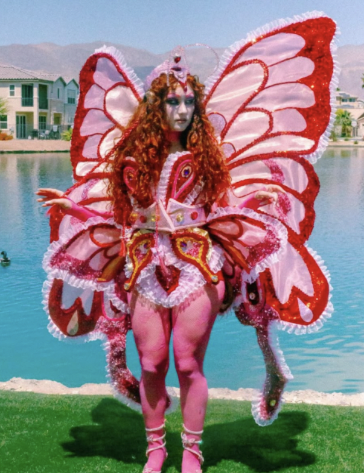
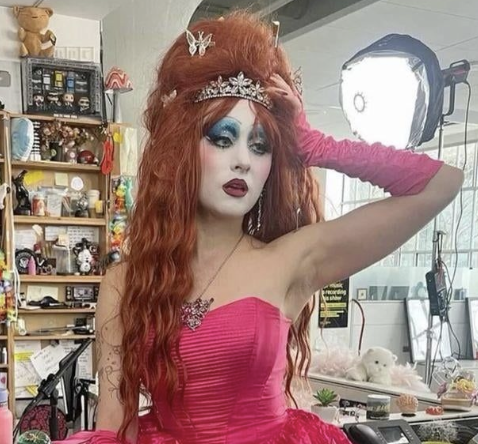
Through all of these topics, Chappell Roan sticks out to me as checking every box, as her identity as a queer woman greatly impacts her stage performance. Chappell Roan is a performance. In case you somehow haven’t heard of her through her quick rise to stardom (do “HOT TO GO!” or “Good Luck, Babe!” ring a bell?), Roan is a 26-year-old pop star and singer/songwriter from Missouri. Off stage, she’s Kayleigh Rose Amstutz, but on stage she becomes Chappell Roan: a campy, outspoken, messy, loud drag queen. Roan’s aesthetic is very uncommon for a musician. She is often sporting bold drag-inspired makeup with white foundation, as well as her iconic curly red hair. Her on-stage looks have included (among others) Lady Liberty, an over-the-top pink butterfly, a white swan and a black swan, an outfit inspired by fellow drag queen Divine, a knight, Marie Antoinette, and her classic “Pink Pony Girl” outfit (a sparkly pink cowgirl). Gender and identity greatly impacts music, and Chappell Roan is an excellent example of this. People all experience the world differently, partly due to gender, and apply their view to their music and their performance (Bessett, 2006). During a concert Roan said, “People in my hometown call gay people clowns, that’s actually why I wear my white face… like b****, I’ll show you a clown.” This shows how Roan’s identity has impacted her performance. Being a lesbian in the Midwest shaped her identity and stage performance, inspiring the iconic white foundation that serves as a base to her makeup looks. Chappell Roan holds herself with pride when onstage, confident in her identity. I see a sense of liberation through Roan’s performance of her identity as a gay woman. She is being completely true to herself, which is incredibly powerful.
Gender has impacted my own performance with music. As a female guitarist, I have seen male guitarists carry themselves like they know they’re better than me. It can be exhausting when you want to be taken seriously as a woman, but when (especially in music) there is a man in your exact situation, he will always be prioritized over you. As a woman, you have to constantly fight the pre-written patriarchal narrative to try and change things for the better. Due to this, my identity as a woman impacts my stage presence. It’s important for me to be loud, open, and not afraid to take up space as a female guitarist. On stage I hold myself the same way, proud with my identity as a female musician and, at the end of the day, just excited to be playing music. I want the women and girls in my life to see me and other strong female musicians and feel empowered, maybe even inspired to pick up an instrument!
Works Cited
Wald, Gayle. “Just a Girl? Rock Music, Feminism, and the Cultural Construction of Female
Youth.” Signs, vol. 23, no. 3, 1998, pp. 585–610. JSTOR,
http://www.jstor.org/stable/3175302. Accessed 17 Jan. 2025.
Rosenberg, Jessica, and Gitana Garofalo. “Riot Grrrl: Revolutions from Within.” Signs, vol. 23,
- 3, 1998, pp. 809–41. JSTOR, http://www.jstor.org/stable/3175311. Accessed 17 Jan.
2025.
Scott, Britain, and Christiane Harrassowitz. “Beyond Beethoven and the Boyz: Women’s Music
in Relation to History and Culture.” Music Educators Journal, vol. 90, no. 4, 2004, pp.
50–56. JSTOR, https://www.jstor.org/stable/3399999. Accessed 27 Jan. 2025.
Bessett, Danielle. “‘Don’t Step on My Groove!’: Gender and the Social Experience of Rock.”
Symbolic Interaction, vol. 29, no. 1, 2006, pp. 49–62. JSTOR,
https://www.jstor.org/stable/10.1525/si.2006.29.1.49. Accessed 21 Jan. 2025.
Dibben, Nicola. “Representations of Femininity in Popular Music.” Popular Music, vol. 18, no.
3, 1999, pp. 331–55. JSTOR, http://www.jstor.org/stable/853611. Accessed 22 Jan. 2025.














mairead • Nov 25, 2025 at 9:49 AM
this is fantastic!!!!